

Singularity: Accelerating Acceleration
The Rate of Change tends to Infinity

We’re living through an era of accelerating technological acceleration, a continuous process driven by compounding innovation. It follows an accelerating exponential curve, flying up faster the faster it gets. This acceleration, driven by the inherent nature of innovation and the profit-seeking logic of Capital, is now approaching an intelligence explosion: self-improving AI. Now comes a time where human minds take the silver, humbled by the aggregated cognitive power of machine intelligence. Past this limit, the world is reshaped, beyond (re)cognition.
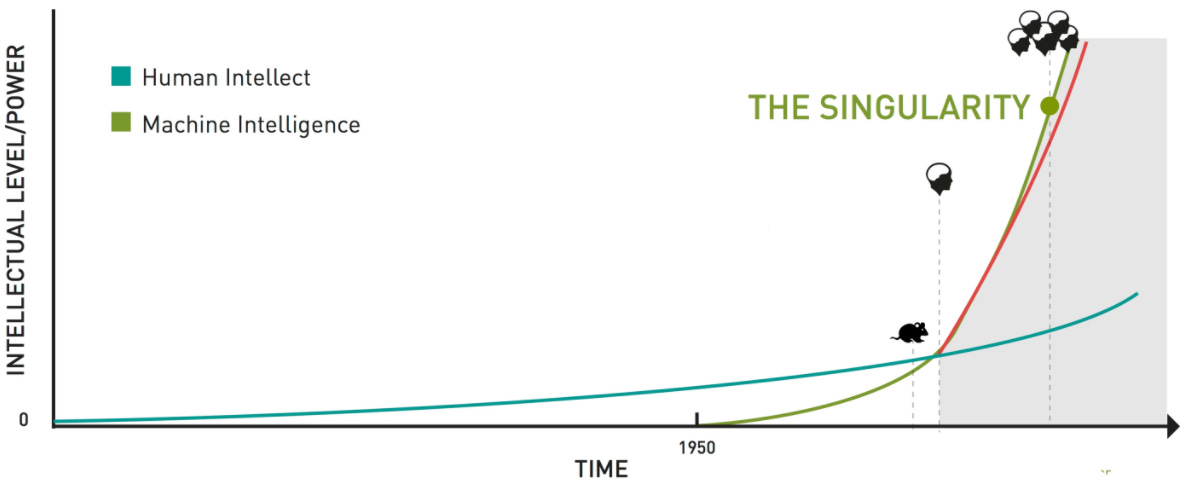
Five years ago, the idea of AI obsoleting all human labor was science fiction. Today, it's an academic debate on primetime evening news. More than just the single moment when we’re doomed to be overtaken, the Singularity can be described as a process of accelerating acceleration. It was very slow at the beginning, like most things in life, before it shoots up. First, nothing. Then, everything at once. Futurologists argue about when the Singularity will exactly begin, or even if it already began. Various viewpoints emerge: the invention of the computer, the linking up of the internet, the future creation of AGI, etc.
I think they’re all wrong. The Singularity isn't tied to a specific technology, but to technological progress itself. Technology accelerates with the sharing of information. The technologies that impulse technology to accelerate faster are technologies that accelerate the sharing of information - informatics - which means that the singularity started a long, long time ago, when Humans first learned to Speak.
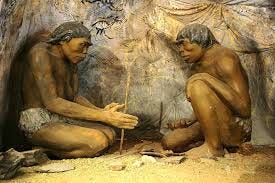
This was our greatest trait. What separated us from animals, before we had warm homes and supermarkets. Knowledge held by one member of the tribe was knowledge shared by all of the naked monkeys. This ability to accumulate and transmit information, however primitive, was the seed from which all future informatics would grow. Stories were our heritage. About how to tame fire, about tales of the terror of predators and of hunting mammoths, how to kill those great beasts. They were passed down through generations, fragile and susceptible to distortion, always confined to the immediate reach of spoken language. The oral tradition, while powerful in its own time, is an inherently slow and localized form of information transfer, a society where change is as a glacier, slowly dragged forward, change measured not in calendar years but lifetimes and wildlife migratory patterns, and it would be millions of years until acceleration made itself known.
But change was dragged. After the ice, comes a breakthrough: Writing. Around 3200 BC, thousands of years before Romulus would become the great fratricide of Empire, the invention of cuneiform script marked a fundamental shift. Knowledge could now be externalized, freeing it from the constraints of human memory. Now it can be mechanically preserved, for further generations, new minds. Information is no longer dependent on nature’s beings. The first great cities of mankind flourished with this pivotal liberation, allowing for the accumulation of information, and it’s transmission across time and distance. It laid the foundation for public administration, complex laws, and complaints about subpar copper. Yet, for thousands of years, the spread of written knowledge remained a painstaking, manual process, limited by the laborious task of hand-copying texts, limiting the transmission of information to the wealthy. The sharing of information was privilege of the rich, whether in the form of powerful rulers commissioning scribes to document their conquests, or the Vatican, employing monks for the copy of Holy Texts, while carefully guarding access to forbidden knowledge. Informatics as a tool of power.
4600 years later, the Printing Press. Introduced in 1440, Gutenberg's invention unleashed a flood of cheaply printed information. Suddenly, books and pamphlets could be produced quickly - and cheaply. Cheap information fermented the intellectual foundation of the Renaissance, the religious upheaval of the Reformation, and the groundbreaking discoveries of the Scientific Revolution. No longer were science and philosophy confined to the halls of universities or the chambers of the powerful. They spilled out into society, engaging a wide audience and accelerating the pace of intellectual and social change. The centuries-long rhythm of slow, gradual evolution was replaced by revolution. A new, dynamic era of new ideas, challenging power structures and reshaping politics. Society would not be the same.
The Telegraph, arriving a mere 400 years after Gutenberg, marked another leap in the human quest to compress space and time. Utilizing electrical signals transmitted through wires, informatic technology decoupled communication from physical transportation. No longer would knowledge be bound by the speed of horses, ships, or even the fastest trains. With the telegraph, information could travel at the speed of electricity. And that seemed like magic.
Just decades later, Telephones followed, and added a human dimension to that instantaneous connection. No longer limited to coded messages, communication became personal, immediate, bridging distances with the sound of emotion.
Radio accelerated communication yet again, with it’s consequences. No longer point-to-point, it enabled a single source to reach, inform, and influence the masses.
1969 births the internet. Lo, first flickers of connection, computers whispering across a wire. But it’s closed off, and no one feels the paradigm shift.
World Wide Web, in 1989. Information flows freely, a torrent of knowledge, ideas, deterritorialized.
In 2007, Smartphones give us permanent connection. The internet in every pocket.
2017. Birth of AI as Large Language Models prove Attention Is All You Need.
2022. ChatGPT goes viral and makes AI popular, it puts on a show.
2024. Reasoning Models. They’ve learned how to think.
2025+ AGI? ASI? The Unknowable.
Acceleration.
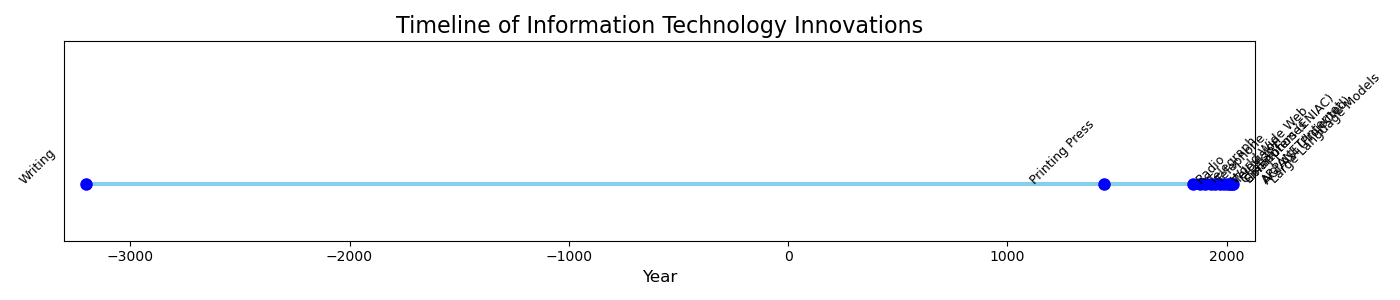
This shrinking interval between breakthroughs isn't just about technology getting faster, it's about the rate of change itself increasing. It's not just linear progress, it's progress that feeds off itself. The invention of the transistor enabled the creation of smaller, more powerful computers. These computers, in turn, allowed for the design of even more advanced, more powerful transistors, accelerating Moore's Law. The internet allowed for global collaboration among scientists, researchers and engineers, speeding up the development and deployment of new technologies, further developing the internet and advancing it’s capabilities. AI is now being used to design better AI, creating a feedback loop that leads to an unprecedented acceleration in intelligence itself. The bigger it gets, the faster it grows. You cannot stop this snowball.
There might be theoretical or physical limits to how fast or how far technology can advance, but the vector is obvious. We’re approaching a rate of change that is, for all practical purposes, incomprehensible. The crucial implication of accelerating acceleration is not necessarily 'infinite' change, but unpredictable change. Human biology, with it’s brains of mere flesh, isn’t prepared for adaptation at this kind of speed. As the rate of acceleration approaches its theoretical limit, our ability to anticipate the next breakthrough, the next technological paradigm, the next societal shift, becomes obsolete. By the time the free market harnesses this acceleration, runaway corporate power arms-races safety regulation in search of profit, and the future is increasingly impossible to foresee. Not just unknown, unknowable. Beyond prediction. Beyond control. We’re brought to the most total consequence of accelerating acceleration: the Intelligence Explosion.
Nothing human makes it out of the near-future.